






Welcome to The Hive Experience, where nurses come to recharge, reconnect, and reignite their passion.
We specialise in immersive retreats and professional events designed exclusively for nurses and midwives.
Whether you're seeking rest, reflection, or career rejuvenation, we create spaces that nourish your wellbeing and elevate your professional journey.
As the sister company to The Hive Nursing Development, we combine decades of clinical leadership, mentoring expertise, and a deep love for the profession to deliver unforgettable, CPD-accredited experiences with purpose.
Burnout prevention
Career clarity
Reflective wellness
CPD hours
Join a movement that celebrates, supports, and uplifts the heart of healthcare, you.


What we offer

Career Clarity
Gain fresh perspective, mentorship, and guided activities to help you reflect on your goals, map your next steps, and leave with a personalised plan to grow your nursing career with purpose.

Burnout Prevention
Our events are designed to help you pause, reset, and reconnect with yourself — reducing stress and providing practical strategies to prevent burnout and build sustainable wellbeing in your nursing career.

CPD Hours
All of our retreats and events are CPD-recognised, giving you the opportunity to invest in your personal and professional growth while meeting AHPRA requirements.

Presented by Lisa Lucas
Founder & CEO @ The Hive Nursing Development
Lisa is an award-winning nurse leader and the visionary behind The Hive Experience and The Hive Development.
With over 20 years of experience across emergency, surgical, oncology, cardiology, and retrieval services, Lisa brings deep insight and compassion to her work.
A passionate mentor and former Nursing Executive level leader, Lisa created Recharge & Refocus to help nurses align their careers with purpose, prevent burnout, and step into leadership with clarity and confidence.
Our Retreats
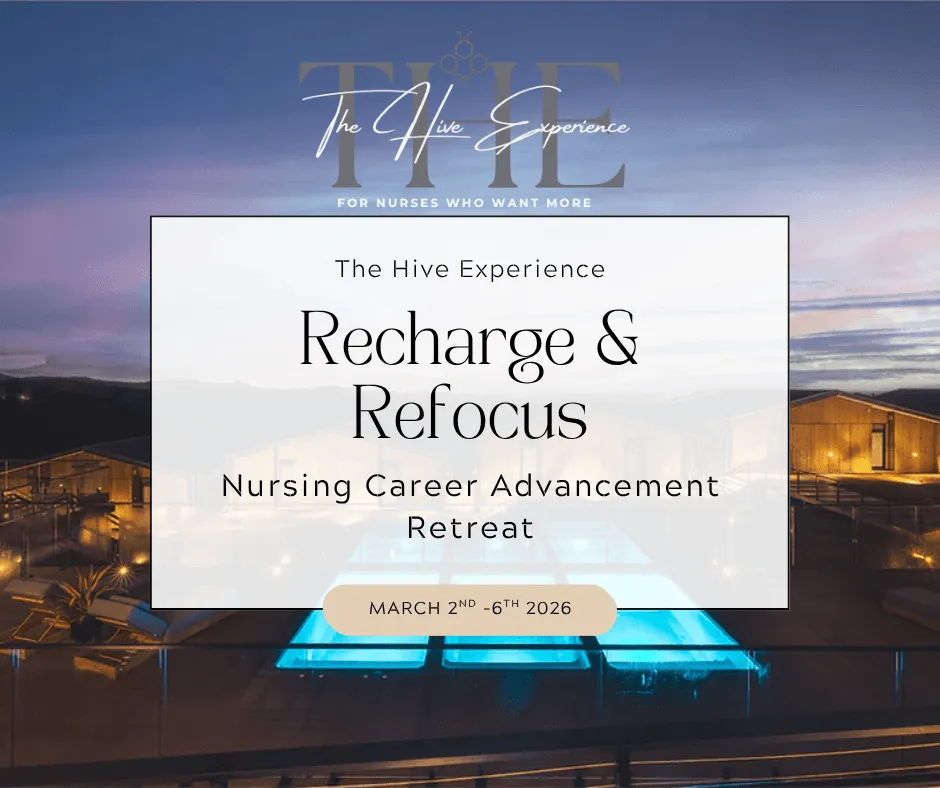
Reset & Refocus - Tallebudgerra QLD
An all-inclusive retreat for nurses and midwives seeking rest, clarity and career growth.
Includes:
5 days / 4 nights luxury accommodation at Eco Retreat, Tallebudgera
All meals crafted by an on-site executive chef (incl. dietary needs)
Full retreat program facilitated by award-winning nurse leaders
Personalised career planning & recruitment preparation workshops
Reflective wellness sessions including:
Guided yoga
Hot & cold plunge therapy
Sauna access
Scenic nature walks
Access to a fully equipped gym
24 CPD hours (AHPRA compliant)
Access to exclusive career resources & take-home workbook
Networking dinners and guest speaker sessions
Retreat gift pack
Follow-up group coaching call
The Hive Escape - Bali
An all-inclusive luxury retreat for nurses and midwives seeking deep rest, emotional recovery and sustainable wellbeing.
5 nights luxury accommodation at Hotel Sages, Bali
Daily yoga and mindfulness sessions
A Bali Spa treatment to relax
Nurse-led wellbeing workshops
Daily nourishing meals (all dietary needs catered)
Cultural immersion experiences
Private airport transfers and on-site coordination

The Hive Cambodia
An all-inclusive Leadership immersive experience that combines humanitarian work with leadership development.
9 nights 5 star luxury accommodation
Volunteer house build with our partners Global Transition
Foundation, to build a house for local families
International flights
Award winning Nurse leader facilitated workshops / immersive sessions
Daily breakfast
Cultural immersion experiences
Private airport transfers

Other events from The Hive Experience...
Career Alignment & Advancement Program
Build clarity, confidence, and a grounded path forward.
2nd March - 5th March (9am - 5pm daily)
What’s Included:
3 full days of guided career clarity and alignment work
Values, identity, and decision-making frameworks
Clear differentiation between burnout and misalignment
Exploration of realistic growth and advancement pathways
Confidence built through evidence, not hype
Practical self-advocacy and boundary-setting tools
A grounded 90-day career action plan
Morning tea, lunch and afternoon tea included
24hrs of CPD with certificate of evidence
Highlights From The Blog

Leadership vs Management in Nursing: What Every Nurse Manager Actually Needs to Know
The Short Answer
Management in nursing refers to the operational and administrative functions of running a unit or team: staffing, rostering, budgeting, policy compliance, performance documentation, and resource allocation.
Leadership in nursing refers to the influence functions: inspiring direction, developing people, shaping culture, modelling values, and creating an environment in which nurses can do their best work.
Both are necessary. Neither is sufficient alone. Most nursing programs train heavily for management and lightly, or not at all, for leadership. The result is units that are administratively functional but culturally depleted.
Why the Distinction Matters in Nursing
The distinction between leadership and management is not an academic one; it produces measurably different team outcomes.
Teams with managers who primarily manage show adequate clinical function and task completion alongside higher burnout rates, higher turnover, and lower morale. Teams with leaders who also manage show clinical excellence, lower burnout, stronger retention, and cultures where nurses support each other through difficulty.
The difference is the presence of leadership capacity in one.
Defining Management: What It Is and What It Does
Management in nursing involves:
-
**Rostering and staffing to ensure adequate clinical coverage
-
**Budget management and resource allocation within funding parameters
-
**Policy development, compliance, and documentation
-
**Performance management, including formal reviews and conduct processes
-
**Incident management and clinical governance reporting
-
**Operational coordination across shifts and teams
These functions are essential. Units that are poorly managed produce clinical environments that are chaotic, unsafe, and demoralizing for nurses regardless of the leader’s interpersonal warmth. Management provides the structural container within which leadership can do its work.
But management alone does not retain nurses. It does not develop them. It does not create cultures where people feel seen, valued, and invested in. It maintains function without creating meaning.
Defining Leadership: What It Is and What It Does
Leadership in nursing involves:
-
**Articulating a clear, compelling vision for the unit’s purpose and standards
-
**Developing individual nurses through coaching, mentoring, and deliberate stretch opportunities
-
**Creating psychological safety - the conditions under which nurses can speak up without fear
-
**Modelling the values and behaviors the leader wants to see in the team
-
**Building trust through consistency, follow-through, and honest communication
-
**Navigating change in ways that bring the team along rather than simply announcing outcomes
-
**Protecting the team from systemic pressures that would compromise clinical standards or individual wellbeing
The Key Differences Side by Side
Orientation
Managers are oriented toward processes and compliance. Leaders are oriented toward people and purpose.
Time horizon
Managers solve immediate problems. Leaders build the conditions that prevent problems.
Influence mechanism
Managers use authority. Leaders use trust.
Development approach
Managers monitor performance. Leaders develop capability.
Culture role
Managers maintain culture. Leaders shape it.
What Happens When Nurses Only Manage
The consequences of management without leadership in nursing are well-documented:
-
**Higher rates of nurse burnout, particularly emotional exhaustion
-
**Higher turnover intention and actual departure from the unit
-
**Reduced psychological safety leading to under-reporting of incidents and near-misses
-
**Team cultures characterised by compliance rather than commitment
-
**Difficulty retaining skilled nurses who have options elsewhere
The manager who runs a tight roster but never asks how their nurses are doing, who handles incidents efficiently but has never had a development conversation, who knows everyone’s performance metrics but not their career aspirations, is producing a team that functions but does not thrive.
What Nursing Leadership Actually Looks Like
The most common misconception about nursing leadership is that it requires special occasions: formal meetings, annual reviews, strategic retreats.
Effective nursing leadership is built in small, consistent, daily moments. It is:
-
**The handover that ends with the question: what do you need from me today?
-
**The feedback conversation initiated before the annual review because the issue was addressed in real time
-
**The acknowledgment of a nurse’s clinical excellence in front of their peers
-
**The conversation where the leader admits they got something wrong
-
**The protection of a struggling nurse from additional pressure during a difficult period
-
**The consistency that allows nurses to predict how their leader will respond to difficulty
How to Develop Both Skills
Most nurses entering leadership roles have been developed for one and not the other. Clinical nursing training develops the systems thinking, attention to detail, and process discipline that underpin management competence. It rarely develops the emotional intelligence, influence skills, and people development capacity that underpin leadership.
Effective leadership development for nurses therefore needs to explicitly address the leadership dimension, not assume it will develop alongside the management learning.
The most effective development pathway combines: structured leadership education that addresses the interior work of leadership identity; mentoring from experienced nurse leaders who model what the integration of management and leadership looks like in practice; and deliberate reflective practice that builds self-awareness as the foundation of leadership effectiveness.
Which Do You Default To?
Most nurse managers, when under pressure, default to one orientation or the other. Under pressure, the manager defaults to process: fix the roster, manage the incident, document the performance issue. Under pressure, the natural leader defaults to people: check in on the team, hold the culture, protect the relationships.
Neither default is wrong. Both need both. The value of knowing your default is that it tells you where your development edge is.
Frequently Asked Questions
Can a good manager become a good leader?
Yes, and this is one of the most important messages for nurses who have strong management competence but have not yet developed the leadership dimension of their role. Leadership capacity develops with deliberate practice and appropriate support. It is not a fixed trait.
Is it possible to lead without a formal management role?
Absolutely. Leadership is an influence function, not a positional one. The most influential nursing leaders in many units are not the NUM. They are the senior clinical nurses whose standards, values, and ways of being set the tone for the whole team.
Join The Hive Nursing Development email community to enquire about leadership development programs for nurses building both the management foundation and the leadership capacity of their role. Visitthehivedevelopment.com.au


The Hive Nursing Development © 2026 | About Us | Contact Us | Privacy Policy | Terms & Conditions